Showing posts with label LGBT in CLE. Show all posts

Wednesday, September 23, 2015

Love Reigns: Nathan and Lukas Trayte

Nathan and Lukas Trayte
Lukas needed a change. He was in a stormy relationship and had been chatting with Nathan for months on the social networking app Grindr. So when Lukas broke up with his boyfriend, he moved to Florida to start a new life. But it didn’t last long. After just a month, he returned to Ohio and moved into Nathan’s house in Berea. Now, six years later, the two live in Cleveland Heights and wed July 10 in Ohio before hosting a private wedding ceremony in Puerto Vallarta July 30. We spoke to them about the importance of family and the benefits of finally being able to publicly announce their love for one another.

Nathan: I spent many years trying to be straight. I had previously been engaged to a woman. So, I had kind of a mental block with the whole marriage thing. Coming out of what would have been a sham wedding, I just had a hard time wrapping my head around that. I knew Lukas was the right person, and even then it still took a while. The winter after we had moved to [Cleveland Heights], we had a house, we were living this life together. It finally clicked. Lukas is fiercely protective, not only of me, but of our family unit. I know that he always has my back.

Lukas: I wear the pants in the relationship, but he’s the belt that holds them up. He’s never held me back from anything. I’ve always admired the fact that he is so family-oriented. My parents came up with my sisters and all their kids right after Thanksgiving last year. I pretty much said, “You either want a relationship or not. Nathan and I are getting married. I want you to meet him. I want you to see where we live.” I frantically decorated the house for Christmas. I got it done an hour before they showed up. It was important to me. You want your parents to accept who you’re with, and they accepted my brothers-in-law. Well, I found someone and I want to show him off too. I always wanted to get married. I wanted a family. I wanted kids. — as told to James Bigley II

Editor’s Note: In the September issue of Cleveland Magazine, we interviewed 10 same-sex couples that were engaged or married following the June 26 Supreme Court decision. Check back every Wednesday for more stories through Sept. 30. For all the stories in this series, click here.

Wednesday, September 16, 2015

Love Reigns: Anne Price and Claudette Cole

Anne Price and Claudette Cole
Anne Price and Claudette Cole, both educators, became friends while working at a local Head Start program. Claudette, now retired from education, had four children from a previous marriage. Their shared passion for art, gardening and education — and their four grandchildren — brought the pair together. Now Anne is the director of the Office of Field Services at Cleveland State University, where she oversees student teachers. On June 26, they put the official seal on their 15-year relationship.

Anne: I grew up gay. I knew I was gay since I was 12 but didn’t come out until I met Claudette. I’d been in a relationship prior but didn’t see the benefit to coming out because there wasn’t any at that point. Growing up in the ’80s, absolutely not. I grew up in a small town outside Columbus, very homophobic, still is, and watched folks that I knew through the Girl Scouts, people I met through volleyball, whose lives were made hell because it came out. As a kid graduating high school in 1984, that was a pretty bleak thought of what could be. [When I met Claudette], she was Jamaican, she was married, she’d had four kids, but there was this energy between us. I was going to be in charge while she left for three weeks to go on a trip. And she called me that evening and wanted to know something dumb like if I had the key, which I think was a farce, and we met. She asked me a question, and I thought the question was, "Are you game?," like can I ask you a question. That wasn’t the question. It was, "Are you gay?" And the answer was, "Yes," to both. That was it, Aug. 1, 1999, and the rest of it was history.

Claudette: I remember one evening, Anne was on one side of the car and I was on the other. You know the Colgate thing, where there’s the little bling on the tube? I could just feel her energy going right into my soul. I felt it, and I was like, uh-oh. I didn’t say anything to her, and I called a friend. We met at Garfield Park Reservation, and my friend said, "What is it?" I said, "I fell in love with a girl." She said, "Shit, I thought you were on drugs!" I’m like, "No!" So she and I talked, and I went to a counselor, who didn’t think it was a big deal. Then I went to my pastor, and he didn’t say anything. I thought, What is wrong with these people? Somebody should find something wrong with this, but they didn’t, they just kept rolling. Nobody said stop, pause, nothing. We’re just so compatible. I wrote her a note that said when God created her in this little town near Columbus, and me in Jamaica, we were bound to come together. — as told to Sheehan Hannan

Editor’s Note: In the September issue of Cleveland Magazine, we interviewed 10 same-sex couples that were engaged or married following the June 26 Supreme Court decision. Check back every Wednesday for more stories through Sept. 30. For all the stories in this series, click here. 


Wednesday, September 9, 2015

Love Reigns: Melissa and Meryl Soto-Schwartz

Melissa and Meryl with their son, Eli

After dating for six months and relocating to Cleveland, Melissa and Meryl Soto-Schwartz had a ceremony in 1997 at the Cleveland Heights Civic Center. Then while on vacation in Vermont in 2000, they had a civil-union ceremony at a library. In 2011, they also had a wedding in front of Niagara Falls with their then-10-year-old son, Eli, as witness in the hopes they could receive some form of legal protection for their family. We spoke to them about the importance of marriage equality and what it means for them now that both mothers have joint-custody of their son.

Melissa: I never thought I could get married, or even find a lifetime partner much less anything like this. We’ve been fighting for so long and to know our son and our whole family is validated and recognized and not at risk is the most incredible feeling. No one can come in and break us up in any way, shape or form, and we won’t be denied anything. Until you’re at the mercy of the law, you don’t know what that’s like. To finally have the highest court in the land say, “You can’t deny these people these rights,” it’s incredible. You are finally recognizing my full humanity.

Meryl: I’m going to be able to legally adopt Eli. Since we’re considered a legally married couple by the state of Ohio and the federal government, I don’t have to worry about that. It’s a new landscape. Because of the huge amount of public attention to these issues, there is nobody in America who is not aware that there are same-sex couples among us, same-sex couples who have all of the rights of the law. Knowing that we are married has a huge psychological boost. What allows me to adopt Eli at this point is that I’m married to his biological mother. So, the process will be the same as for a stepparent adoption. Now, of course, I am not Eli’s stepparent, I am simply his mother. But in the end, it won’t matter. In the end, my name will be on a new birth certificate and he will have two mothers, and that will be that. — as told to James Bigley II

Editor’s Note: In the September issue of Cleveland Magazine, we interviewed 10 same-sex couples who were engaged or married following the June 26 Supreme Court decision. Check back every Wednesday for more stories through Sept. 30. For all the stories in this series, click here.

Wednesday, September 2, 2015

Love Reigns: Keith Garrett and Chris Richardson

Keith Garrett and Chris Richardson

Keith Garrett and Chris Richardson were the first same-sex couple to tie the knot in Cuyahoga County. Though they professed to be marrying simply to give their 18-year relationship the weight of legality, things got a little emotional when the pair broke out in tears and embraced in Judge Anthony Russo’s courtroom. We spoke with them about what it means to finally be legal and finding acceptance in family.

Keith: We never really sought any kind of religious acknowledgement. We never sought religious matrimony. Our relationship wasn’t based on any of that. We have a strong relationship — we didn’t need that. What this was important for was getting the legal recognition that traditional couples get just by having a marriage license. There are something like 1,100 rights that it automatically conveys. There’s only so much you can do with powers of attorney and rights of survivorship. That sounds cold, because you’re not talking about any love there. But the love was never in question. The love never needed to be recognized publicly. The legal part was what we sought.

Chris: My mother is very supportive. My parents got divorced when I was very young. My father, he is as supportive as I could expect him to be. He turned 70 this year, and he grew up in a very small town in the mountains of southwest Virginia. He grew up with those values where being gay was unheard of. It was instilled in him at a very early age that it was unacceptable. Without diving into some of the things that he said to me when I came out to him, he has come a long way. When we first got together, we went out to eat, and my dad would talk to him without actually looking at him. We sat at a square table, across from him and my stepmom, and she wouldn’t look [Keith] in the eye. And two years ago, they came up here and stayed Labor Day weekend with us. The fact that they came up was huge. I actually went down recently to see my dad, and he made a comment, basically saying, ‘You know I don’t like the fact that you’re gay, but if this is what makes you happy I support you.’  That is more than I ever thought he would say. — as told to Sheehan Hannan


Editor’s Note: In the September issue of Cleveland Magazine, we interviewed 10 same-sex couples who were  engaged or married following the June 26 Supreme Court decision. Check back every Wednesday for more stories through Sept. 30. For all the stories in this series, click here.

Friday, February 20, 2015

3 to Know: Legacies of the Gay Games


Panel from left to right: David C. Barnett, ideastream senior reporter and producer; John Grafton, board member, Gay Community Endowment Fund of the Akron Community Foundation; Phyllis Harris, Thomas Nobbe and Michelle Tomallo

As snow swirled outside and below zero temperatures enveloped the town, the City Club of Cleveland bell rang once again. Just more than six months after the closing ceremonies of Gay Games 9, a panel met Feb. 19 to discuss the lessons and legacies of the Gay Games. For our August 2014 cover story, we did the same, examining the impact and difficulties of the LGBT community on Cleveland, centered around the games. Economically, the Gay Games were estimated to have had a $52.1 million impact. Nearly 75 percent of games attendees came from outside of Cleveland.

Safety was a top priority, said Phyllis Harris, executive director of the LGBT Community Center of Greater Cleveland. Her organization conducted 40 trainings at the Cleveland Police Department academy over 40 weeks before the games. Harris led some of the classes herself, teaching 40-50 police officers at a time. "It was scary and it was life changing," she said. "In a way I think it set the tone for much of the training that continued to happen throughout the year."

The community center is in the process of purchasing a new headquarters building with an anonymous $1.8 million donation, announced during the games. The center has been located in a Gordon Square storefront since 1999. The network established during the games was instrumental to their move, said Harris. "People listen if I call now," she said. "They want to collaborate now, they had a good experience."

Here's three things you need to know from the discussion:

1) The 2014 Gay Games were the most profitable in the history of the organization, finishing with a surplus of $150,000. "From the outset of planning the games, our board and staff were really determined to see that these games finished in the black," said 2014 Gay Games executive director Thomas Nobbe.

2) The $150,000 surplus will be donated, with 80 percent going to form a new Gay Games legacy fund at the Cleveland Foundation, and 20 percent to the Gay Community Endowment Fund of the Akron Community Foundation.

3) Though the Gay Games were certainly a symbol of progress, both the panel and attendees were quick to emphasize that Ohio does not provide legal protections for same-sex couples. "We had all this grand success and there was all this celebration. It literally was palpable, all the energy, vibrancy and love," said Michelle Tomallo, president of the board of directors of Plexus, the LGBT chamber of commerce. "All of that happened in the context of a state where we don't have any protections for the exact people that we're celebrating."

Friday, November 7, 2014

Reclaiming Womanhood: Laverne Cox Speaks at Case Western Reserve University

Orange is the New Black actress Laverne Cox spoke about gender issues at CWRU. Photo Credit: Ryan Zymler

From the moment Case Western Reserve University president Barbara Snyder  introduced Laverne Cox to the time the actress stepped off stage, she commanded attention. Cox delivered a speech at the campus last night. Her role as prisoner Sophia Burset on Orange is the New Black has thrust her into the national spotlight and helped her break barriers from being the first transgender person to get nominated for an Emmy to being the first transgender person to grace the cover of Time Magazine. And on Monday, she will accept a Woman of the Year award from Glamour Magazine — a publication that celebrates women of beauty and power — alongside Lupita Nyong'o, Chelsea Clinton, and Samantha Power.

"I stand before you this evening a proud African-American transgender woman," she said upon approaching the podium. "I stand before you tonight an artist, an actress, a sister and a daughter, and I believe it is important to name the various intersecting components of my multiple identities because I'm not just one thing, and neither are you."

Cox then highlighted alarming statistics to set the stage for discussing transgender issues. For example, the homicide rate in the LGBT community is highest among trans women, according to the National Coalition of Anti-Violence Projects. In 2013, over 72 percent of all LGBT homicides were trans women, 67 percent of which were trans women of color.

"It is my belief that one of the biggest obstacles facing the transgender community are points of view which disavow our identities," she said, "points of view that suggest that no matter what we do, we are always and only the gender that we are assigned at birth, points of view that suggest no matter what I do, I'll never be a woman yet. Ain't I a woman?"

She went on to talk about how she was bullied growing up, often beaten by her peers while she ran home from school, and how she attempted suicide in sixth grade. She also talked about how she persevered, devoting herself to dancing and acting classes, clinging to her twin brother for emotional support, and ultimately undergoing hormone therapy and starting her transition into womanhood 16 years ago.

"As long as we live in a culture where people have to prove their womanhood or their manhood, we are not living in a culture where we are all truly free in terms of gender," she said. "We have to begin to create spaces of gender self-determination for all of our youth and all of our society."

Thursday, October 23, 2014

Radio Show Host Ken Schneck Says Cleveland is So Gay


It's been seven years since Ken Schneck's radio show, This Show Is So Gay aired its first episode in Brattleboro, Vermont. Two hundred and eighty episodes later, the associate professor and director of the Leadership in Higher Education Program at Baldwin Wallace University is hosting the show in Cleveland. "The central theme of the show is, 'How can you use your voice in your own unique way to make a difference?' " says Schneck, whose show is broadcasted online and on iTunes. "I wanted to reclaim the idea of something being 'so gay' and actually have it be so gay."

His next guest coming up, 19-year-old Caleb Laieski, is a former commentator on the show. At 15 years old, he was trying to build transitional housing for homeless LGBT youth, but now he's returning for the 281st episode after he filed the first ever federal lawsuit against the Food and Drug Administration to fight the ban on gay men donating blood. "I can't think of a guest on the show who hasn't had the most incredible experience," Schneck says, having hosted everyone from emerging indie-pop stars A Great Big World to openly gay comedian Suzanne Westenhoefer.

We asked Schneck to give us three things that make Cleveland so gay, and he delivered.


1. The LGBT Community Center of Greater Cleveland is stealing the spotlight after receiving a $1.8 million donation and a $500,000 matching grant from the Milton and Tamar Maltz Family Foundation to relocate and expand its facility. "Everyone should be keeping their eye on what's going on there, because they're going to continue to take an even greater role in building community here in Cleveland," says Schneck. "They already do incredible work, but I think they're on the cusp of just upping the ante even more."

2. Cleveland welcomed LGBT visitors and allies from all over the world in August to participate in the Gay Games 9 by flying rainbow flags all over the city — and some of them are still flying. "[These] visual artifacts make such a difference for visitors and for people who live here, and it sends a really strong message in a state that is in the minority right now," he says, noting that Ohio does not have marriage equality and employment protection.

3. Sometimes it's all about the good vibrations — and Cleveland is still roaring with pride months after the Gay Games left. Just next month, on Nov. 2, the LGBT center is hosting an event to keep that momentum going. "There seems to always be some sort of rally or book reading or drag show where you can go and meet new people," he says. "It's one of those things that you can easily take for granted, but given the larger umbrella of the lack of equality in Ohio, Cleveland is definitely so gay."

Wednesday, August 20, 2014

How Gay Are We: Out in the Open


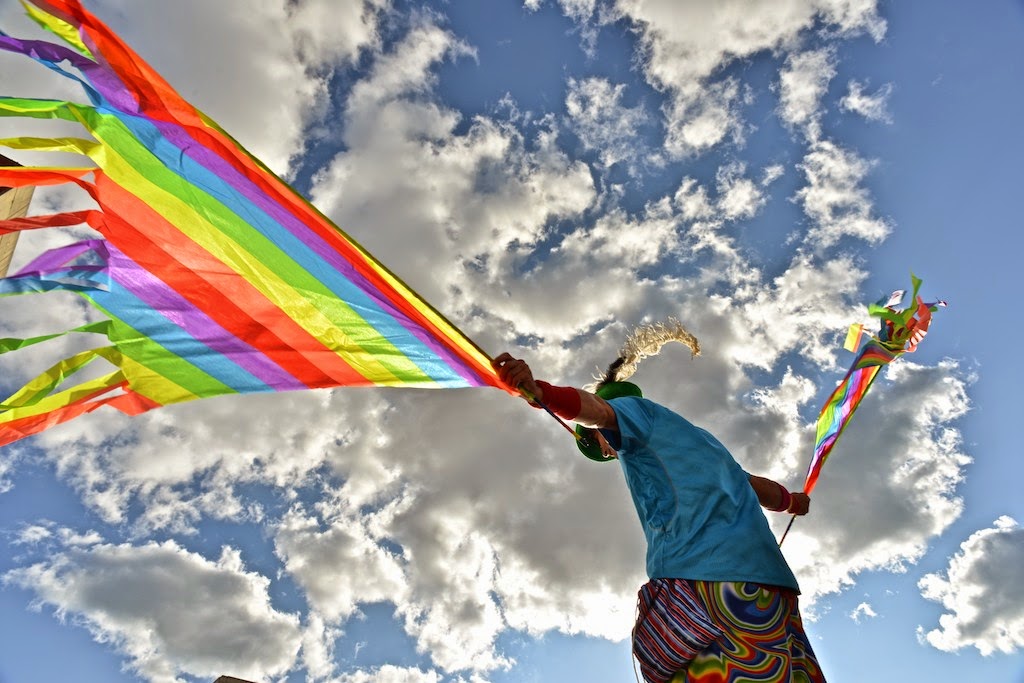
The Global Rainbow at Aha! Festival of Lights.
The sign read “gender-neutral bathroom.” It was posted at the Cleveland Museum of Art during the pre-Gay Games party, Night Before 9, and for me, it was not just a cardboard cutout – it was a step toward inclusion for Cleveland. Our city hasn’t always been kind to the transgender community — just last year there were a series of attacks that led to the deaths of three women and discrimination from local news sources. To see such an important institution be accepting of gender expression and welcome the transgender community —which has for a long time remained invisible and often overlooked — it was as if the city itself had opened its arms.

As a member of the LGBT community, I was speechless during the opening ceremonies at the Quicken Loans Arena when participants from San Francisco carried a massive rainbow flag as spectators stood and cheered them on. And when the Russian Federation entered the arena, greeted by a standing ovation after having suffered from so much persecution at the hands of their own government over the last year, I cried. I was not only overwhelmed by the tremendous amount of love and grace that was being lifted up, but also from being a single gay man united with thousands of individuals who applauded the perseverance of those who have suffered, celebrating pride in self-expression and honoring all of those who felt they didn’t have a voice. I never thought I would ever see something like it in my lifetime — a place in which everyone was united in their individuality regardless of race, class, sexual orientation or gender. By the end, I was convinced that Cleveland was proud that the Gay Games had arrived in our city.

I returned to Akron telling all my friends how incredible it was that there was so much freedom of expression in Cleveland. Having lived in several small towns in Northeast Ohio where being gay was never openly discussed nor expressed, I couldn’t help but boast how amazed I was that Cleveland was changing the game. My friends saw it for themselves, too — having grown used to suppressing public displays of affection — they were shocked by how many same-sex couples were holding hands and embracing one another in Public Square. They couldn’t stop talking about how great it was that City Hall was flying the LGBT flag, and only after checking with one another whether it would be OK, did they reach for the others’ hand.

Toward the end of the week, I was stopped by a visitor from San Francisco who asked, "Are the people of Cleveland always this nice?" I thought about it as we walked side by side down a dark street toward the rainbow-lit Terminal Tower and away from GG9 Festival Village where hundreds of strangers were dancing with each other under neon-colored lights. When we reached the corner, I stopped and said, "No, Cleveland hasn't always been this open, but it's been getting better over the last five years." He nodded his head, congratulated me on how polite we all were, and then asked if Cleveland had always been this gay. I couldn't help but smile, considering the cover of this month's issue of Cleveland Magazine, but when I finally turned to give him an answer all I could say was, "We've always been here. We've just been waiting for the right time."

There have been more advances in LGBT activism in our country in the last 10 years than there have been in the last 100. With 19 states now supporting same-sex marriages and 21 states offering nondiscrimination laws to protect LGBT individuals, Ohio isn’t that far behind. We’ve created domestic partner registries, we’ve started begin to recognizing same-sex marriages from other states, and we have openly-gay officials in office such as state Rep. Nickie Antonio, who is actively fighting for nondiscrimination laws to protect the LGBT community at home and in the workplace.

As GG9 came to an end, I kept thinking about where we might go from here and what needs to happen next. And while there’s certainly a lot of work left to be done at the state level, I returned to those nights out on Mall C where everyone danced, to those quiet dinners where gay couples reached across the table to hold hands and to those moments when gay athletes were cheered on.

Whether the pride flags come down or they remain flying, Cleveland should hold on to the hope that this has been and can be a city where we all live without judgment, able to love freely and be who we really are 100 percent of the time.

Sunday, August 17, 2014

How Gay Are We:GG9 Ends with Hot 7 Deadly Sins After-party


The Gay Games closed its weeklong event with a rather steamy, sinful bash at the House of Blues Saturday night. With dimmed lights, candle-lined bars and local go-go boys personifying the seven deadly sins, the official after-party was underway. Celebrity transgender model, Amanda Lepore invited Murray Swanby, Pablo Hernandez and Cory Zwierzynski from Andrew Christian, a popular men's underwear line, onto the stage after Real Housewives of New York City star Carole Radziwill hand-selected 10 hunks from the crowd to dress down and dance alongside them. Famous for their music videos and known for targeting the gay community with their brand, the Andrew Christian models threw free underwear into the crowd before joining the party. As the night went on, models danced on elevated platforms while several members of the crowd stripped down, and when the lights came on at 2 a.m., it was clear that no one really wanted to leave it all behind.

Murray Swanby, Pablo Hernandez, Cory Zwierzynski and Amanda Lepore

Carole Radziwill and Amanda Lepore looking fabulous in the Foundation Room

The Andrew Christian boys take the stage.


Friday, August 15, 2014

How Gay Are We: Oven Productions Has Been Celebrating Female Pride for Nearly 40 Years

Debra Hirshberg doing sound production for Oven Productions in the '80s.
Debra Hirshberg was a Case Western Reserve University senior in 1975 when she read a front-page article in the women’s newspaper, What She Wants, about the opening of a female-only production company. As a technical theater minor yearning to use her lighting skills, she called Oven Productions and has been involved with the nearly-40-year-old lesbian-feminist nonprofit ever since. The group hosts Hot Time in Cleveland, a women-only dance party, featuring disc jockey Zoe Renee Lapin at the Trinity Cathedral 8 p.m. tonight. 

         In 1974, the first National Women's Music Festival was held at the University of Champaign-Urbana. A woman in Cleveland came back from that and said, 'We have to start a production company.' It was the beginning of what was known as women’s music — music that stoked feminist and lesbian ideas. No one was producing them. So, we wanted to create a community of production companies to help get their music out. From '76 to maybe '82, we did probably 10 or so productions a year.

   It was a time where you didn't really see much feminist or lesbian stuff reflected in popular culture. We weren't on TV. ... There weren't many out performers.
     
      We started a lot of organizations, because they weren't there. There was no rape crisis center. There was no battered women's shelter. There was no coalition for women. In 1975, the UN had its International Women's Year Convention in Cleveland. They brought many women together, both lesbian and straight, and ideas came from that.

    We used to be the only place to go to for [lesbian-feminist productions]. We did concerts, music, dance, theater. We did a variety show every year to raise money; initially to buy sound equipment and then to just fund our concert series. In 2015, it’s going to be the 40th anniversary of the variety show, and some of us have been doing it all those years!

      Last year, we said, 'We've got to throw a party for the Gay Games.' It's a big celebration of Cleveland and the lesbian-feminist community. We wanted to welcome the women from out of town — come party with us.

     Bringing the Gay Games to Cleveland — it’s because people in Cleveland say, Why not? I think in Cleveland — we dare to dream, and we do it. We don't let things get in our way. — as told to Frances Killea

Pride in the Moment: Day Five

Pride is not holding back. Local photographer Shane Wynn snapped this vibrant shot at the daylong Flair Fest, held at Akron's Lock 3 Thursday, that encouraged crowd members to accentuate their unique qualities while they took in music from the Indigo Girls and local and regional acts. Wynn and three other photographers continue to capture the games for Summit Artspace's online exhibit Pride in the Moment where new images can be seen daily at prideinthemomentgg9cle.com, prideinthemomentgg9cle.org, akronareaarts.org and gg9cle.com. Check back tomorrow for another picture from the exhibit.

Flair Fest, Lock 3, Aug. 14
Photo Credit: Shane Wynn

Thursday, August 14, 2014

Pride in the Moment: Day Four

The Gay Games brings out true competitors. Cleveland-area photographer Billy Delfs shot this image of an ice hockey player at the OBM Arena in Strongsville Wednesday. See more pictures from Delfs and three other area photographers in Summit Artspace's online exhibit Pride in the Moment at prideinthemomentgg9cle.com, prideinthemomentgg9cle.org, akronareaarts.org and gg9cle.com. Check our blog each day for another photo. 

Ice Hockey, OBM Arena, Aug. 13
Photo Credit: Billy Delfs

Wednesday, August 13, 2014

How Gay Are We: Choir Teacher Runs to Raise Funds to Support Youth


Mario Clopton admits he is lucky. When he came out at 21 years old, he had a strong support network. "Whether I came out at 13 or 21, I knew my family was going to be there for me," he says. But he Shaker Heights choir teacher is aware that not every kid is as lucky. So he decided to run in the Gay Games half marathon this Saturday and raise $40 a mile to donate to youth programs at the LGBT Community Center of Greater Cleveland. So far, he's raised $600. “I look at some of these kids and their families are abandoning them, but they are steadfast," he says. "They still have their goals, and I felt that I have to support them in some way. Listening to their stories and how strong they are just inspires me.”

Common Ground: He has been pleased to find people from all walks of life at the games, even those outside the LGBT community. “I was waiting in line for a drink, and the guy in front of me turned around," Clopton says. "It was one of my teacher friends, and he was there with his girlfriend. I mean everyone feels welcome here.”

Chief Moment: Clopton took a year off from college to campaign for then-Sen. Barack Obama. So he was ecstatic when the president expressed his support for the games via a video shown at the opening ceremony. “Sometimes it just kind of seems, as a gay man, that the stars and stripes doesn’t include you," he says. "But when I saw that I was like, ‘The gay community is represented in that flag.’”

Sidewalk Therapy: As a choir teacher, Clopton says there is constantly noise in his head. “Running allows me to just clear that space and just have time with myself,” Clopton says. Struggling with attention deficit hyperactivity disorder as a child, Clopton found that running was a great combatant. “I didn’t want to take medication, because it made me not feel like myself so my doctor said, ‘Well, you should try running to get rid of some of that energy.’ I was going into seventh grade, and I signed up for cross-country. I loved it, and the rest is history.”

Pride in the Moment: Day Three

Pride is the ability to authentically share your identity with others. The Gay Games is certainly bringing that out in athletes such as this martial arts competitor photographed by David Alan Foster at the John S. Knight Center Tuesday. See more pictures snapped by Foster and three other area photographers as part of Summit Artspace's Pride in the Moment online exhibit documenting the international sporting event at prideinthemomentgg9cle.com, prideinthemomentgg9cle.org, akronareaarts.org and gg9cle.com. Visit our blog daily this week for an exclusive photo from the exhibit. 

Martial Arts, John S. Knight Center, Aug. 12
Photo Credit: David Alan Foster

Tuesday, August 12, 2014

How Gay Are We: Boy George Rocks the White Party


  The crowd waved glow sticks, spun flags and threw up inflatable beach balls as dancers grooved with glow-in-the-dark Hula-Hoops to the high-energy beats of internationally known disc jockey, Marc Vedo, and Cleveland-based Evan Evolution at the Gay Games White Party. Despite a torrential downpour, hundreds dressed in head-to-toe white filled Jacobs Pavilion at Nautica Monday night. Host Veranda L'Ni,  who also hosts Twist Social Club's Drag Bingo, announced $1 for every White Party ticket would be donated to a new LGBT fund at the Cleveland Foundation in memory of John Katsaros, longtime gay activist and former owner of Twist who died in February.

 Boy George, the former Culture Club frontman who just released his first full-length album in more than 18 years, took control of the LED-lit DJ booth, mixing cult classic's such as the Eurythmic's "Sweet Dreams (Are Made of This)." Partygoers included Mary Zaller, director of development for the Gay Games, Jennifer Downey, owner of Ambiance, and Gay Games executive director, Tom Nobbe. "I was talking to some ladies who are here from the United Kingdom and they said, 'I hope it's alright to say but I'm thinking that Cleveland is the San Francisco of the Midwest,"said Nobbe earlier in the evening. "We've been telling our region for the last two years that the Gay Games are coming, and they are stepping up and welcoming everybody and that is what this is all about."
Photo Credit: Maria Varonis
Scott Christensen, Mark Boedtker, Veranda L'Ni, Eric Kruzyk and Paul Demming
Photo Credit: Maria Varonis
The Rock N' Roll City Sisters of Perpetual Indulgence
 Photo Credit: Maria Varonis
Mary Prevel and Mary Zaller
 Photo Credit: Maria Varonis
DJ Marc Vedo spins.
Photo Credit: Maria Varonis
Boy George masters the DJ booth.


Pride in the Moment: Day Two

As thousands of LGBT and straight athletes compete daily, the Gay Games stirs up emotion for all involved. Akron-area photographer Shane Wynn caught this poignant image at the International Gay Rodeo Association's rodeo Monday as a part of Summit Artspace's Pride in the Moment online exhibit that documents people involved in the games. See more from Wynn and three other photographers at prideinthemomentgg9cle.com, prideinthemomentgg9cle.org, akronareaarts.org and gg9cle.com. Check our blog each day this week for an exclusive photo from the exhibit.

IGRA Rodeo, Summit County Fairgrounds, Aug. 11
Photo Credit: Shane Wynn